ComForCare Home Care
Get Started!
  • Home   >> 
  •  Blog   >> 
  •   At-Home Exercises for Seniors: Helping Your Loved One Stay Safe and Independent
  • At-Home Exercises for Seniors: Helping Your Loved One Stay Safe and Independent

    Making the decision to help an aging parent stay active isn’t just about fitness—it’s about preserving their independence and your peace of mind. For many adult children in the “Sandwich Generation,” seeing a parent become less mobile brings a wave of worry about falls and safety.

    Unfortunately, only 15.5% of adults aged 65 and older get enough physical activity to meet federal aerobic and muscle-strengthening guidelines, according to recent CDC and Healthy People 2030 data. For many seniors, exercise can feel out of reach. When your loved one is aging in place, exercise is the single most effective tool for fall prevention.

    In this guide, we’ve outlined 12 safe, low-impact exercises designed to help your parent stay strong without leaving the comfort of home.

    Safety First: A Caregiver’s Prep Checklist

    Before your loved one starts moving, ensure their environment is as safe as possible to prevent the very injuries you’re trying to avoid.

    • Check Footwear: Ensure they are wearing sturdy, non-slip shoes (no loose slippers).
    • Clear the Path: Remove area rugs or cords that could cause a trip.
    • Hydration Station: Have water nearby; seniors often don’t feel thirst as acutely as younger adults.
    • The “Sturdy Chair” Rule: Use a dining chair without wheels for any seated or supported movements.

    12 Best Low-Impact Exercises for Aging in Place

    Note: Always consult with your parent’s primary care physician before starting a new routine.

    Phase 1: Warm-Up (5 Minutes)

    1. Gentle Neck Rolls: 5 times in each direction to reduce tension.
    2. Arm Circles: 10 circles forward and backward to improve shoulder mobility.
    3. Seated Ankle Circles: 10 circles per foot to improve circulation and joint flexibility.

    Phase 2: Balance & Fall Prevention

    Improving stability is the key to managing fall risks at home.

    1. Single-Leg Stand: Hold a chair for support. Lift one leg for 10 seconds.
    2. Heel-to-Toe Walk: Walk 10 steps in a straight line, placing the heel directly in front of the toe.
    3. Marching in Place: 30 seconds of high knees to build hip strength.

    Phase 3: Seated Strength Exercises

    These exercises are ideal for seniors with limited mobility or those who tire easily.

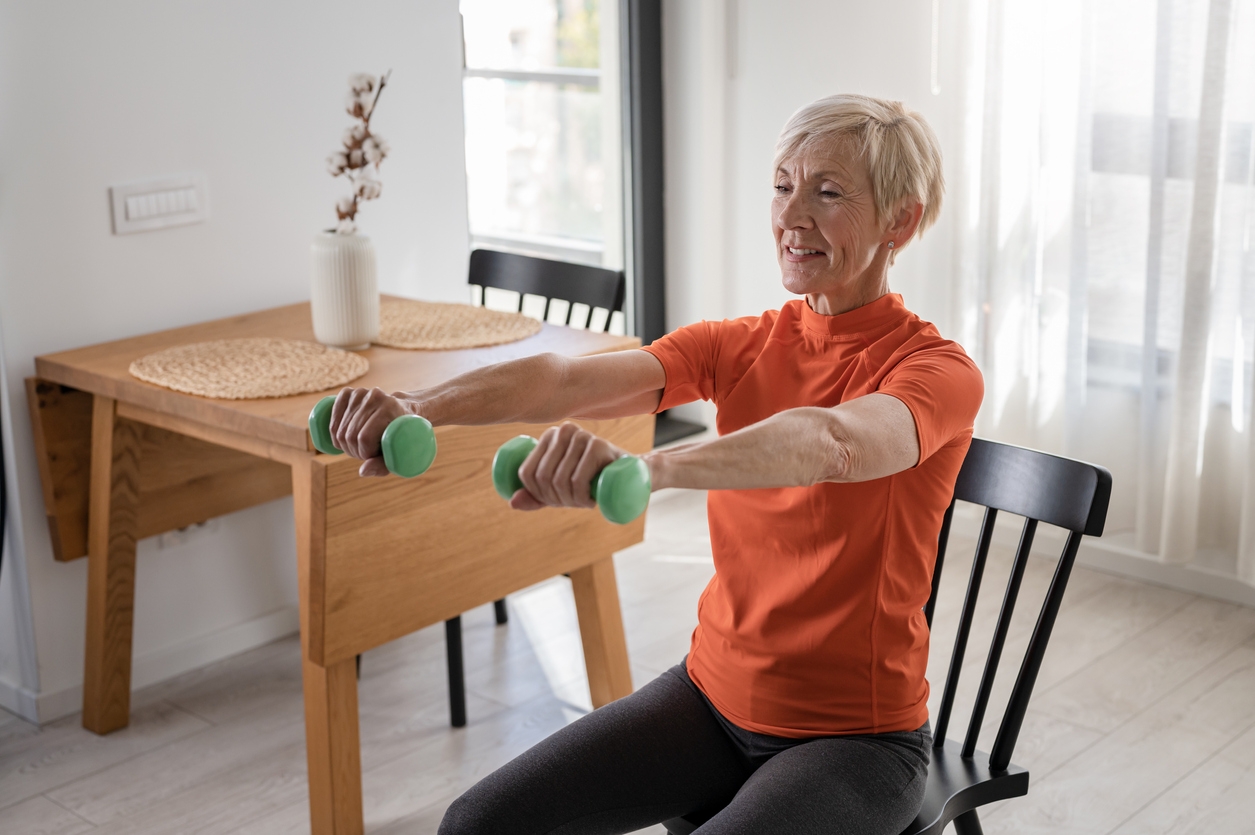
    1. Bicep Curls: Use light water bottles or soup cans. 10–12 repetitions.
    2. Shoulder Shrugs: Raise shoulders toward ears to maintain upper body posture.
    3. Seated Heel Raises: Lift heels off the floor to strengthen calf muscles and aid balance.
    4. Leg Extensions: While seated, straighten one leg at a time to build quad strength.

    Phase 4: Core Stability (The Harvard Method)

    Strong core muscles support the spine and prevent the “slump” that leads to falls.

    1. The Knee Plank: A beginner-friendly version of the classic plank performed on the knees.
    2. Bird-Dog: On all fours (or seated leaning forward), extend the opposite arm and leg to improve coordination.

    Motivation Tips: What to Do if They Resist Exercise

    It’s common for seniors to feel discouraged by age-related pain or a fear of falling. As a daughter/son, your role is “Coach,” not a “Nag.”

    • Frame it as Independence: Instead of saying “you need to get healthy,” try “this will help you keep living here on your own.”
    • The “Exercise Snack” Method: Don’t push for 30 minutes. Suggest 5 minutes of movement during commercial breaks.
    • Do it Together: Make it a social activity during your weekly visit.

    When Exercise Needs a Safety Partner

    If you work full-time or live far away, you might worry that your parent isn’t safe exercising alone. This is often the point where families begin comparing home care vs. home health care.

    Professional caregivers can provide the “eyes and ears” you need, ensuring your loved one performs their movements safely, stays hydrated, and avoids the risks of isolation.

    How ComForCare Can Help

    Our personalized senior care services are built around the “Gaitway” philosophy—proactive movement to prevent decline. Our caregivers can:

    • Provide a steady hand during daily walks or balance exercises.
    • Monitor for signs of fatigue or mobility changes.
    • Help manage chronic conditions like Parkinson’s or Dementia that affect movement.

    Help your loved one live their best life possible. Find a ComForCare location near you today or call us 24/7 at (800) 886-4044.


    Verified by the ComForCare Care Team | Updated February 2026

    Over 250 ComForCare Locations Nationwide

    We're Here to Answer Your Questions

    Each office is independently owned and operated
    and is an equal opportunity employer.

    © 2026 ComForCare Franchise Systems, LLC.

    (click the 'x' to close this pop up)
    Considering In-Home Care?
    We have your
    perfect caregiver.
    For care, please fill out the form below.
    For employment, please go to careers.

    ComForCare is committed to protecting and respecting your privacy.

    By checking this box, I agree to receive text messages (SMS) from ComForCare. Message frequency may vary. Message and data rates may apply. You can reply STOP to opt-out at any time. For assistance, reply HELP. Check our Terms and Privacy Policy

    For details on data handling, please visit our Franchisee Privacy Policy here. Message and data rates may apply. The frequency of messages varies. Reply HELP for assistance or STOP to unsubscribe.

    or call (800) 886-4044.

    Services vary by location. Please contact us to see what services are available in your area.