
Get Started!

Families often hear “hospice” and “home care” used in the same conversation, and it’s easy to assume they’re the same thing. They’re not. Understanding hospice vs. home care in Massachusetts can make a difficult decision a little clearer, especially when a loved one’s needs are changing quickly.
Here’s how the two actually compare.
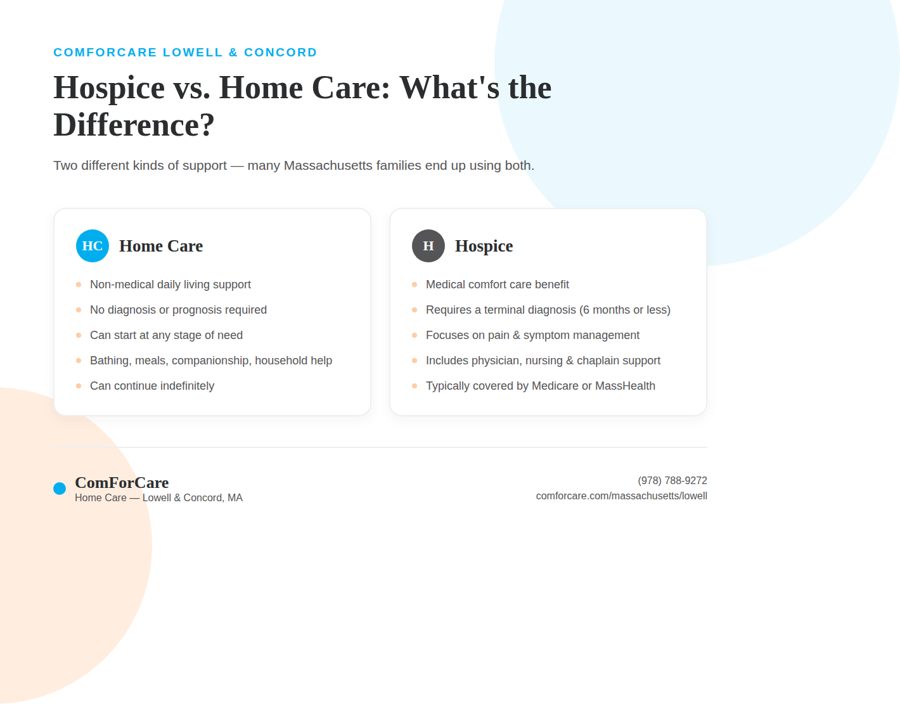
Home care is non-medical support delivered wherever someone lives. It covers things like bathing, dressing, meal prep, medication reminders, companionship, and help around the house. There’s no diagnosis or prognosis requirement. Home care can start at any stage of need, and it can continue indefinitely.
Hospice is a medical benefit for people with a terminal diagnosis and a life expectancy of six months or less, if the illness runs its expected course. It focuses on comfort rather than cure. That means pain management, emotional and spiritual support, and specialized nursing care. Hospice is typically covered by Medicare, MassHealth, or private insurance.
Home care is about daily living support. Hospice is a medical program built around end-of-life comfort care. One isn’t a replacement for the other. They’re designed for different needs, and in Massachusetts, many families use both.
A common pattern looks like this: home care provides the day-to-day companionship, personal care, and household help, while hospice manages medical symptoms and pain. The two services usually coordinate rather than compete. A hospice team focuses on medical care, while a home care caregiver focuses on comfort and consistency between hospice visits.
If a loved one’s needs are primarily about daily living, home care alone may be enough. If a doctor has raised a terminal prognosis, it’s worth having a conversation with hospice providers too. Many families use both, and a good home care agency will work alongside your hospice team rather than around it.
If you’re weighing your options, our care team serving Lowell and Concord can talk through what a coordinated care plan might look like for your family. And if you’re also trying to figure out how to pay for whichever path you choose, our post on paying for home care in Massachusetts breaks down the options.

Each office is independently owned and operated and is an equal opportunity employer.
© 2026 ComForCare Franchise Systems, LLC.