
Get Started!

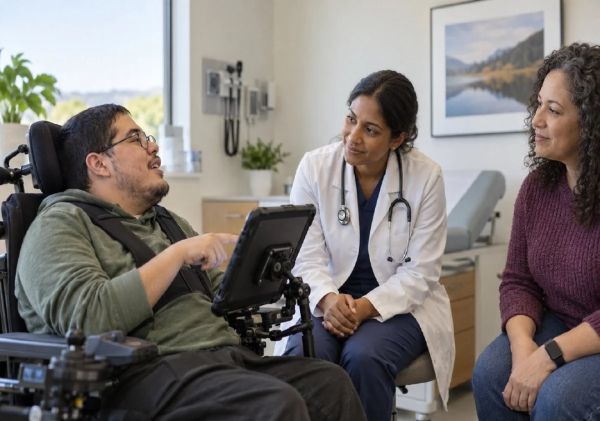
A health appointment is most helpful when a person can understand what is happening, ask questions, express concerns and participate in decisions about their care.
For people with communication disabilities, being able to participate may require more than simply speaking louder or repeating a question. Some individuals may communicate best with plain language, pictures, writing, a communication device, an interpreter, extra processing time, a familiar supporter, or other individualized accommodations.
Communication access starts before the appointment begins.
In October 2026, researchers published the protocol for the Documentation of Communication Disability Collection and Accommodations in Primary Care Settings (DECA) study. The pragmatic trial is planned to involve 10 clinics across five health systems.
Researchers will evaluate strategies for documenting communication-disability status and accommodation needs in electronic health records and then providing requested accommodations.
It is important to understand what this publication does and does not show. The article describes what researchers plan to study. It does not yet provide results showing that the intervention worked or improved patient outcomes.
The study highlights an important issue: knowing that someone has a communication disability is not necessarily the same as knowing how that person communicates best.
Many people with communication disabilities may have to explain their needs repeatedly when meeting new professionals.
Important information can be lost during scheduling, intake, rooming, an examination, or follow-up. A family member or caregiver may be asked to answer questions even when the patient can communicate with the right support.
A medical record may identify a diagnosis without explaining what actually helps that individual participate.
Useful documentation can make that information more practical.
For example, it might note that a person:
These details can help a care team prepare before the person arrives.
At the same time, documentation should never become a permanent assumption. Communication needs and preferences can change because of fatigue, stress, illness, sensory conditions, the environment, or the topic being discussed.
The best approach is to document helpful information while continuing to ask the person what they need.
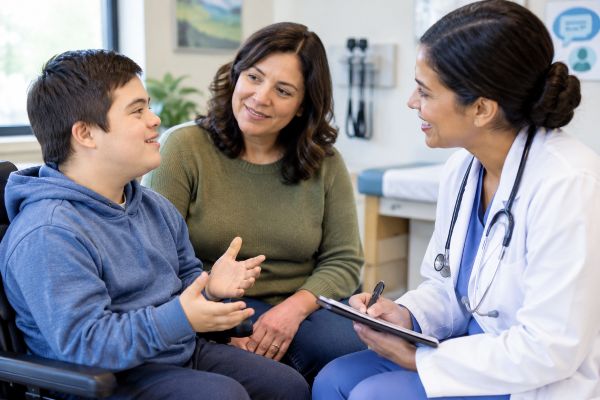
Families, caregivers, supporters, and healthcare professionals can use four simple questions before an appointment.
Consider whether the person benefits from:
Communication may include:
The goal is not to identify one “correct” way to communicate. The goal is to understand how this individual communicates.
The environment can affect communication, too.
A person may communicate more comfortably with:
Small changes can sometimes make it easier for a person to participate.
A family member, caregiver, or support professional may help explain unfamiliar communication, operate equipment, provide relevant history, or help the person prepare for the visit.
But support should not automatically mean speaking for the person.
Whenever possible, healthcare professionals should continue addressing the patient directly and give the person an opportunity to respond.
A short communication profile can help important information travel with a person across different settings.
With the individual’s permission, it might include:
Keep the information current and protect private information.
A communication profile should support conversation, not replace it.
Families and patients may want to ask the healthcare office:
These questions can help move communication access from something addressed at the last minute to something the care team prepares for in advance.
For people receiving Regional Center services, families may also wish to discuss communication goals and support needs with their Service Coordinator and other relevant professionals. Services, funding and authorization vary, so individual decisions should be based on current official guidance.
In-home support can also help a person maintain familiar routines, organize appointment materials and prepare communication tools when those activities are consistent with the individual’s care plan and preferences.
No diagnosis tells a healthcare team exactly how a person communicates.
Some autistic people prefer identity-first language, while others prefer person-first language. Some people use speech and also benefit from AAC. Some want a family member involved in appointments, while others prefer greater privacy.
There is no one communication approach that works for everyone.
The most respectful starting point is to ask.
When communication preferences are understood before an appointment, patients have a better opportunity to participate in conversations about their health and care.
At ComForCare Home Care North & East San Diego, we believe personalized support begins with understanding the individual, their routines, preferences, communication style and goals. When appropriate, our caregivers can provide non-medical support that helps individuals and families prepare for everyday activities and appointments while respecting the person’s choices and independence.
Medical information note: This article is for educational purposes only and does not replace advice from a physician, speech-language pathologist, or other qualified healthcare professional.

Each office is independently owned and operated and is an equal opportunity employer.
© 2026 ComForCare Franchise Systems, LLC.