
Get Started!

| Quick Answer: For part-time care needs, assisted living at home is typically the more budget-friendly option since you pay only for the hours used, while assisted living communities charge a flat monthly rate that often adds separate fees as care needs grow. In-home care also means your loved one keeps their own home, routine, and one-on-one attention, rather than adjusting to a shared facility environment. |
Choosing between assisted living and assisted living at home is one of the harder decisions a family faces, and it rarely comes with a clean answer. Families across Shrewsbury, Red Bank, Little Silver, Tinton Falls, Rumson, and Fair Haven usually start this search the same way: comparing cost, comfort, and how much independence their loved one gets to keep.
This guide walks through both options honestly, so you can make a confident decision rather than guessing.
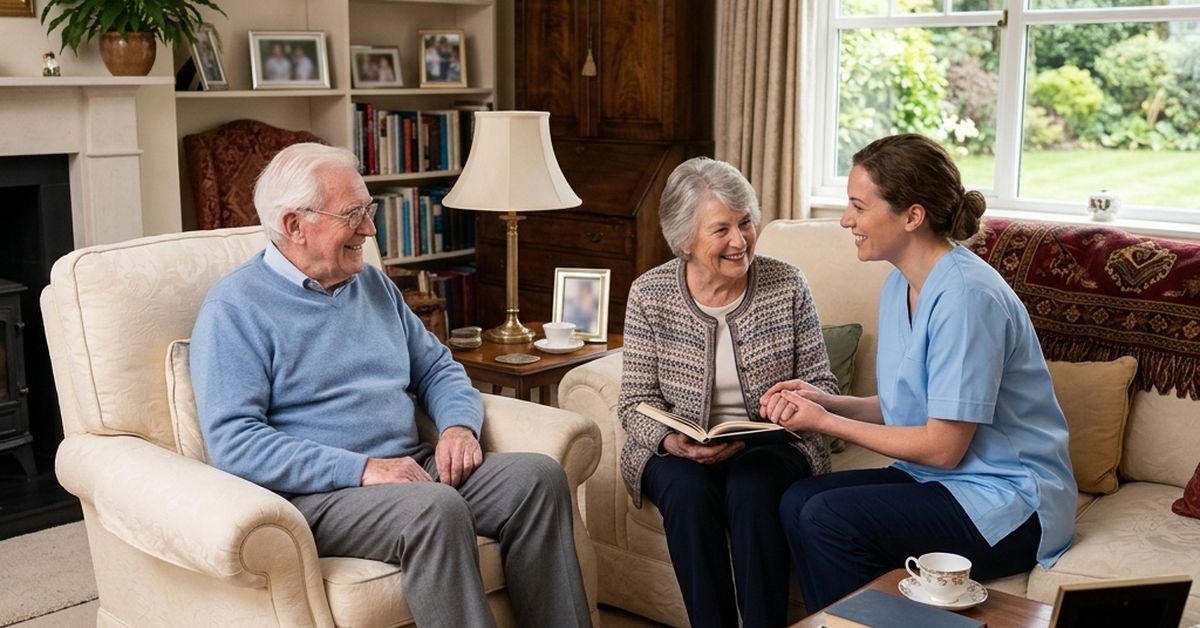
In-home assisted living means professional, non-medical support delivered in the home your loved one already knows, including help with daily activities, meal preparation, mobility, and companionship, without requiring a move.
Assisted living communities are residential facilities providing housing, shared meals, and group-based assistance. They can work well for older adults who want a built-in social environment and are ready for that transition.
Cost is usually the first question families ask, and the honest answer is that it depends heavily on how many hours of care are actually needed. In-home care is billed hourly, so families pay only for the support actually used, which tends to make it the more budget-friendly option for part-time needs. Assisted living, by contrast, is billed as a flat monthly rate that often looks all-inclusive at first but frequently adds separate “care tier” fees for medication management, bathing assistance, or mobility support once those needs arise.
Because pricing changes based on your loved one’s specific needs and the level of care involved, the most reliable way to compare true costs is a free in-home consultation, where we can walk through your family’s situation and give you a clear picture, rather than a generic number that may not apply to your situation.
Staying in the Shrewsbury home your loved one already knows avoids the stress of relocation, and it means keeping the same neighbors, the same routines, and the same sense of control over daily life.
In an assisted living community, one staff member is often responsible for a number of residents at once. In-home care flips that ratio entirely: one caregiver, one client, with a plan built around your loved one’s actual schedule and preferences.
When one spouse needs more support than the other, in-home care allows both partners to remain together at home, rather than facing separate facility placements or the cost of two assisted living fees.
Our transition of care team coordinates closely with local hospitals to support a safe return home after a hospitalization, including cardiac care and stroke recovery. For families managing memory loss, our caregivers train through the DementiaWise® Certified Care Program, an approach built around calm, predictable routines for older adults living with Alzheimer’s or dementia. Explore our full dementia care services to learn more.
We proudly support veterans, helping them access the benefits available to them, and we offer the GUIDE Program for eligible Medicare beneficiaries living with dementia. Please note that we do not accept Medicaid; we accept Medicare only through the GUIDE Program.
“ComForCare is a wonderful agency. The whole staff was so knowledgeable and kind! Working with the intake coordinator Denise and the owner Mike was a pleasure, not to mention our wonderful caregiver!”
— Robin Proctor, via Google Reviews
Is in-home care cheaper than assisted living in Monmouth County?
For part-time needs, in-home care is often the more affordable option since you pay only for the hours used. As care needs grow toward full-time or 24/7 support, the cost gap narrows. A free in-home consultation gives you numbers specific to your family’s situation.
Can in-home care help after a hospital stay?
Yes. Our transition of care team coordinates with local hospitals to prepare the home in advance, manage medications, and support a safe recovery, including after cardiac events or stroke.
What if care needs increase over time?
Care plans are reviewed regularly and can scale up from a few hours a week to full 24/7 live-in support, without requiring a move to a new facility.
How do we get started with a care assessment in Shrewsbury?
Call us or request a free in-home consultation. We’ll assess your loved one’s needs and walk through your options, including cost, with no obligation.
There’s no universally right answer between in-home care and assisted living, only the answer that’s right for your family’s specific needs, budget, and values. If you’re weighing the options, we’re glad to help you think it through.
Call ComForCare North Monmouth at (732) 889-1430 or schedule a free in-home consultation today.

Each office is independently owned and operated and is an equal opportunity employer.
© 2026 ComForCare Franchise Systems, LLC.