
Get Started!


TL;DR: Isolation doesn’t just make older adults sad. Research published in December 2025 confirms it has a direct causal effect on cognitive decline, independent of whether someone feels lonely. Purposeful engagement slows that process and lifts mood. This post covers what the science says, which activities actually work, local resources in San Marcos and Kyle, and how ComForCare’s Meaningful Activities program gives seniors the connection they need.
You visit for the holidays and notice something hard to name. Your parent seems fine. They’re eating, the house is tidy, and nothing looks unsafe. But the gardening tools are dusty. The books on the nightstand haven’t moved. The TV is always on, but they can’t quite tell you what they’ve been watching.
Their world has gotten quieter and smaller, and what’s worse, they probably don’t realize it. This is what senior isolation looks like in real life. It’s rarely dramatic, which is exactly what makes it easy to miss.
Research increasingly links social isolation to faster cognitive decline in later life. Regular, meaningful time with another person is one of the most practical things you can add to an aging parent’s week. November is National Family Caregivers Month, which makes now the perfect time to look at how engagement fits into the care your family already provides.
It’s easy to think of isolation as an emotional problem, something a few extra phone calls can fix. Researchers increasingly see it as a brain health issue, too.
In 2023, the U.S. Surgeon General issued a formal advisory on loneliness and isolation, calling it a public health epidemic. The advisory found that poor social connection in older adults is associated with a 50% higher risk of developing dementia, along with higher risks of heart disease and stroke. The comparison that tends to land hardest: the health consequences are comparable to smoking up to 15 cigarettes a day.
Isolation is also common. In the University of Michigan’s National Poll on Healthy Aging, 29% of adults ages 50 to 80 said they felt isolated at least some of the time in 2024. That’s up from 27% in 2018.
When older adults go most days without much conversation or company, their thinking skills tend to decline faster. A 2025 study of more than 30,000 Americans found this held true even for people who said they didn’t feel lonely. A parent who seems content at home may still be missing something their brain needs.
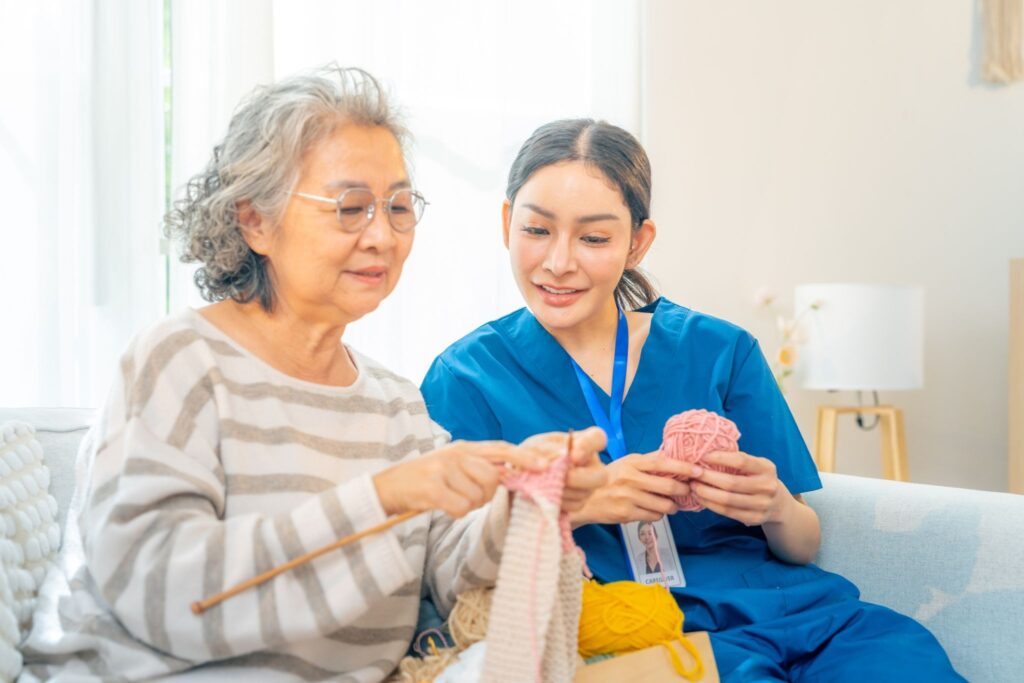
Not all activity is equal. Watching television for several hours a day keeps a person occupied but doesn’t stimulate the brain the way active, purposeful participation does. There’s a real difference between passive consumption and genuine engagement.
Researchers from Johns Hopkins and Drexel University found that engagement in personally relevant activities reduced depression, improved functional independence, and produced better memory performance in cognitively healthy older adults. For people with dementia, the same gains in independence and mood appeared. What made the difference wasn’t the activity itself, but whether it was something the person actually cared about.
An 82-year-old woman who spent decades cooking for her family gets more out of stirring a pot than a crossword puzzle, even if the crossword is considered more cognitive. A retired carpenter who can no longer build furniture may thrive sorting hardware or talking through a project. Connection to identity is what activates the benefit.
Not necessarily. What matters is that activities are regular, interactive, and tied to something the person actually values. A daily walk with real conversation, a shared meal that includes cooking together, or ten minutes with old photos all produce genuine engagement. Frequency and personal relevance matter more than format.
The strongest activities connect to a person’s history and adapt to their current abilities. A few that reliably produce results:
Nearly every activity on this list works better with a partner. That person keeps things moving, adjusts when something gets frustrating, and turns a task into a conversation.

Time at home is only part of the picture. If your parent is able to get out, community programs along the I-35 corridor offer regular social contact and something to look forward to.
For families affected by Parkinson’s disease, the Lone Star Parkinson Society runs a support group in New Braunfels, along with exercise programs designed for people living with the disease.
The San Marcos Senior Citizens Center on Arizona Street is operated by Community Action Inc. of Central Texas. It offers arts and crafts, field trips, low-impact exercise, and assistance for connecting with other local services.
The Kyle Area Senior Zone (KASZ) is a local nonprofit that has supported adults 50 and older for about two decades with lunches, classes, and social events. The City of Kyle has also been building the Adell Hurst Senior and Community Center on Dacy Lane to expand senior programming.
With all of these great activities, the issue is often getting there. If your loved one no longer drives, a companion caregiver can provide transportation to a senior center lunch, a support group, or a weekly card game.
Even with local resources available, there are hours and days when a senior needs company and engagement that family can’t provide. That’s where companion care makes a real difference.
Companion care is non-medical support at home. They don’t just sit with someone but bring structure and engagement into a day that might otherwise be quiet and empty. That can include conversation, activities, meal preparation, light housekeeping, errands, and transportation. For many family caregivers, it fills the hours between visits, workdays, and taking care of children.
At ComForCare New Braunfels, our Meaningful Activities program builds engagement directly into the care plan. We start with a social history assessment to learn what each client has done, enjoyed, and valued across their life, then bring those things into their daily routine. Our goal is at least one meaningful activity during every shift, and families can view planned activities and suggest new ones throughout our secure Family Portal.
Music is part of the plan for many of our clients. Our Joyful Memories® program uses personalized playlists and music-based activities, especially for people living with dementia.
The caregiver matters as much as the plan. We hire fewer than 2% of applicants, and we match caregivers to clients based on skills, availability, location, and personality. Our owners, Chad and Andrea Otte, take part in in-home assessments, so the people planning your parent’s care have seen how they live day to day.
A visit might include cooking lunch together, working on a puzzle, looking through photos, listening to music, or taking a short walk. Caregivers also offer something harder to schedule: a familiar face on a predictable routine. For older adults living with memory changes, that consistency can make the day feel more manageable.
If you provide most of your parent’s care, a companion visit also gives you time to rest, run errands, or spend an afternoon as their son or daughter instead of their caregiver. That time helps you keep supporting your parent over the long run. Our respite care can cover a few hours or longer stretches when you’re away.
Yes, often more severely. As dementia progresses, many people have a harder time starting conversations or activities on their own, so they rely more on others to create chances to engage. Regular companionship and activities matched to their current abilities can help them stay involved in daily life.
Start with what your parent has always enjoyed, and build small, regular activities around it, such as cooking a favorite recipe, listening to music from their younger years, or tending a few plants. Doing these activities alongside another person usually adds the most value. That person can be a family member, a neighbor, or a companion caregiver.
The research says yes. Social isolation directly accelerates cognitive decline. Introducing a trained, engaged caregiver who provides regular, genuine social contact works against that process. It isn’t a substitute for medical care and can’t reverse existing decline, but it can measurably slow it and preserve quality of life. For many families, that’s exactly the difference they’re hoping to make.
It depends on your parent’s needs and when help would make the biggest difference. ComForCare New Braunfels schedules shifts of four hours or more, with no weekly minimum, so you can start with one visit a week and adjust as needs change.
Senior socialization and cognitive health are connected in ways most families don’t fully appreciate until something goes wrong. The science is clear, the stakes are real, and the solutions are more accessible than many families realize. If your loved one’s world has been getting quieter, it’s always worth a conversation.
ComForCare New Braunfels serves families throughout New Braunfels, Kyle, Cibolo, San Marcos, Seguin, and the surrounding communities. Call us at (830) 632-5887 or visit our website to schedule a free in-home consultation and learn more about Companion Care.

Each office is independently owned and operated and is an equal opportunity employer.

© 2026 ComForCare Franchise Systems, LLC.